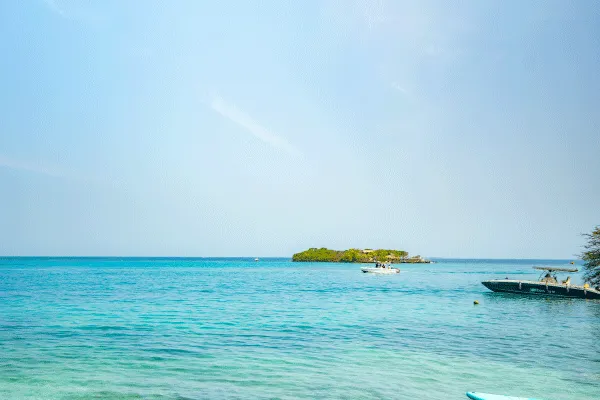
Rosario Islands Facts You Didn’t Know
1. The most important coral reef in the Colombian Caribbean
The Rosario Islands are part of the Corales del Rosario and San Bernardo National Natural Park, one of the most important marine protected areas in Colombia. Its coral reef system is the largest and most diverse in the country, home to more than 1,300 species including fish, mollusks, crustaceans, and corals.
These reefs are not only stunning in appearance — they are vital to coastal protection, sustainable fishing, and ocean balance. Swimming in these waters means entering a vibrant world that continues to surprise us with its complexity.
2. A hidden underwater cemetery
In the depths off the coast of Isla Grande lies a small and mysterious underwater cemetery, formed by submerged crosses and cement structures. For years, it inspired rumors of shipwrecks and sea legends, but its origin is more recent: it was built as part of an underwater art installation, and now serves as a refuge for corals and fish.
This lesser-known site sparks the curiosity of divers and travelers seeking to explore the archipelago’s more unconventional corners. It’s a reminder of how human creativity can respectfully integrate with nature.
3. Isla Pavitos: the island that appears and disappears
One of the archipelago’s most unusual formations is Isla Pavitos, a strip of white sand that appears and disappears with the tide. On low tide days, it becomes a tiny uninhabited island where you can walk on dry sand surrounded by turquoise sea. Hours later, it sinks again — as if it had never been there.
This geographic rarity is a clear reminder of how alive the Rosario Islands' ecosystem really is. Nothing is static: the landscape shifts, breathes, and moves with the waves.
4. The Oceanarium: living science in the middle of the sea
On Isla San Martín de Pajarales is the Oceanarium of the Rosario Islands, a marine education and research center where visitors can get up close with species like sharks, turtles, dolphins, and stingrays.
This isn’t a traditional aquarium: it’s built on floating platforms, and most of the animals live in direct contact with the sea. The initiative raises awareness about marine conservation and the impact of human actions on marine ecosystems.
5. Ancestral heritage beyond tourism
Long before becoming a tourist destination, these islands were navigated and inhabited by Indigenous and Afro-descendant communities who created routes, rituals, and sea-related practices. Today, the residents of Isla Grande and nearby islands keep those traditions alive through artisanal fishing, ancestral singing, and natural medicine.
Exploring the islands with local guides not only enriches the visitor’s experience, it also contributes to preserving these vibrant cultures. The history of the Rosario Islands is also the story of their human guardians.
6. An ecosystem under constant threat
Although the Rosario Islands may seem untouched and timeless, they are not free from danger. Overfishing, unregulated tourism, and climate change are silently affecting their coral reefs. Ocean acidification reduces the corals’ ability to regenerate, and rising sea temperatures cause bleaching.
That’s why it’s so important for visitors to adopt responsible practices, such as avoiding contact with coral, skipping chemical products in the water, and supporting community-led activities. Every mindful action helps this ecosystem remain a refuge for marine life and a national treasure.
7. Communities living in harmony with the sea
These islands are more than natural beauty: they are home to Afro-Colombian communities who have developed a profound cultural relationship with the sea. In places like Isla Grande and Isla del Rosario, traditions like artisanal fishing, tidal knowledge, and spiritual rituals tied to water have been passed down for generations.
Many of the tour guides, cooks, and fishermen who now welcome visitors are guardians of that ancestral knowledge. Choosing experiences that involve them not only supports their economy but also helps preserve their cultural identity.
How to reach the Rosario Islands responsibly
From Cartagena, the islands can be reached via authorized boats departing from the Muelle de la Bodeguita. To minimize environmental impact, it's recommended to travel in boats with sustainable practices: electric or low-consumption engines, guides trained in conservation, and tours with visitor limits.
An option that combines comfort, design, and environmental awareness is PA'UE Beach Lounge, which offers not only an exclusive beach club experience but also connects travelers to the history and ecosystems of the archipelago through immersive, conscious tourism.
Beyond tourism: a call to protect
Visiting the Rosario Islands is a transformative experience — but also a responsibility. Understanding what makes them unique is just the first step. The next is to protect, value, and respectfully share their story.
Those who dive into their waters or rest beneath their palms should know they are entering a sacred territory — for biodiversity, and for the Caribbean’s collective memory.
An experience that goes beyond the scenery
Learning these facts turns a regular visit to the Rosario Islands into a much richer experience. At PA'UE Beach Lounge, strategically located to connect travelers with the best of the archipelago, every detail is designed so that guests not only enjoy themselves — but also learn, wonder, and connect.
From paddle board tours to cocktails by the sea, PA'UE is the ideal starting point to experience these curiosities up close.
Discover more about this one-of-a-kind experience at www.paue.com.co


